
Buy Research chemicals Online
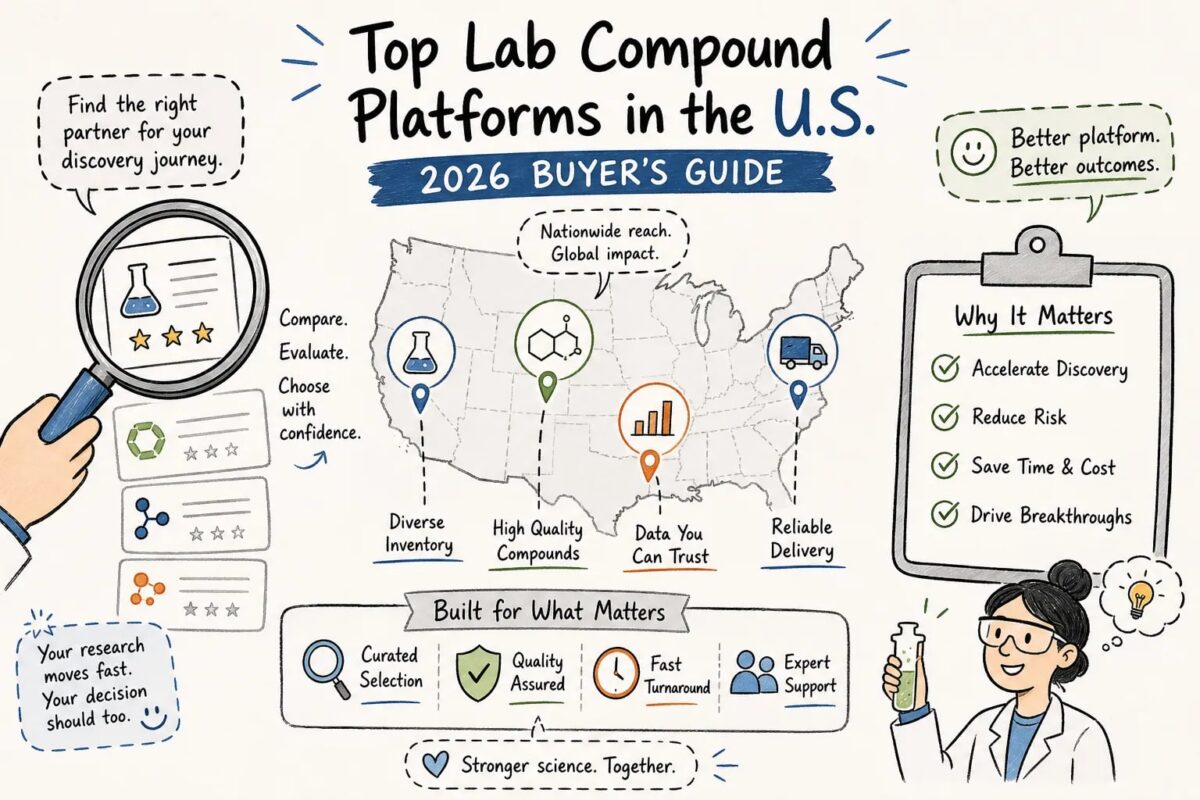
Top Lab Compound Platforms in the U.S.: 2026 Buyer’s Guide
Sep
When evaluating top lab compound platforms in the USA, U.S. researchers quickly discover a consistent pattern: a platform looks credible until it doesn’t. The catalog is large, the homepage looks clean, and then the labeling is inconsistent, the shipping window is undefined, or the compliance framing disappears when procurement documentation requires it. The time lost to these gaps is real, and it accumulates across projects.
This guide evaluates platforms around four operational criteria that experienced procurement teams and lab managers actually use: product labeling consistency, manual pre-listing review, domestic shipping reliability, and compliance transparency. These are the criteria vendors rarely advertise but that determine how a platform performs when a project is already underway. They also map directly to what compound library platforms and chemical inventory management workflows require at the institutional level.
Research Chem Hub was designed around these same four standards. By the end of this guide, you’ll have a practical shortlisting framework and the right questions to bring to any vendor conversation before procurement commits.
What actually separates reliable compound platforms from the rest
The four criteria researchers should use to evaluate any platform
Catalog size and price point are easy to compare. They’re also poor proxies for platform quality. A platform with hundreds of SKUs and competitive pricing can still fail a procurement review if its naming conventions are inconsistent or its research-use framing is buried in footer text.
The four criteria that actually matter are labeling consistency, manual pre-listing review, domestic shipping reliability, and compliance transparency. These aren’t abstract standards. They’re the operational details that surface when a procurement officer audits a supplier or when a researcher needs to cite a compound name consistently across a study and its supporting documentation.
Why so many platforms fail on the basics
The most common failure pattern isn’t fraud. It’s indifference to structure. Platforms that grow by adding SKUs quickly often rely on automated listing pipelines that import product data without standardization. The result is naming inconsistency across compound families, category labels that shift depending on how a product was added, and research-use framing that appears on some listings but not others.
At the institutional level, this creates real friction. Ambiguous listings slow procurement approvals because reviewers can’t confirm whether a compound matches internal classification requirements. Inconsistent labeling complicates safety documentation and study records. These aren’t small problems. They compound over time and across projects, and they don’t resolve themselves.
Product labeling consistency: the detail most platforms overlook
Fixed naming conventions and category architecture
Genuine labeling consistency means fixed naming conventions applied uniformly across every product listing, predictable category structures that don’t shift between compound families, and explicit research-use-only framing applied consistently across applicable SKUs. That’s not a high bar in principle. It’s a surprisingly rare one in practice.
The operational reason this matters is straightforward. Researchers cite compound names across studies, procurement records, and safety documentation. If a platform uses three slightly different naming formats for the same compound class depending on when a product was added, that inconsistency travels downstream into every document that references it. Correcting it later is tedious work that a well-structured platform makes unnecessary.
Top Lab Compound Platforms USA: How to Shortlist by Auditing the Catalog
Before committing to any supplier, run a simple audit: search for the same compound class from multiple angles. Use the category navigation, the search bar, and a direct compound name search. Check whether naming, categorization, and research-use labeling hold up consistently across all three paths. This approach mirrors the compound screening protocols that institutional EHS reviewers often apply during vendor evaluations.
Platforms relying on automated listing pipelines tend to show more variation here than those using human review at the pre-listing stage. If the category label changes between search results or the research-use framing appears on some products but not others, that’s a structural signal, not a one-off error. Treat it accordingly.
Why the manual review process changes what researchers can trust
Pre-listing verification as a quality standard, not a bottleneck
Every product listing on a well-structured platform should go through category placement validation, naming confirmation, and research-use framing verification before it goes live. In a well-designed compound registration system, this isn’t a slow process; it’s the process that makes the catalog trustworthy.
The contrast is with platforms that prioritize SKU volume through automated pipelines. Speed at listing often means errors at the research desk: inconsistent names, miscategorized products, or missing research-use framing on listings that require it. Research Chem Hub states that every product goes through a manual verification sequence covering category placement, naming validation, and consistency confirmation before a listing is published. That process is slower than automation. It’s also designed to ensure the catalog holds up under scrutiny when a procurement review lands.
How verification processes affect your internal documentation trail
For compliance-conscious procurement staff, a supplier’s verification process is more than an internal quality measure. It’s a traceable signal you can reference when a listing goes through institutional review. Being able to point to a supplier that documents its pre-listing process, rather than one that adds products at volume without review, can smooth internal procurement approvals in ways that price discounts cannot.
Academic and institutional labs often require procurement decisions to be justified to EHS reviewers or purchasing committees. A supplier with a documented verification process gives you something concrete to reference. That’s a practical advantage, not a theoretical one.
Domestic shipping reliability and verified U.S. operations
Why a verified U.S. business address is more than a detail
A documented, verifiable domestic business address is an accountability signal. It means the supplier has a real operational presence you can reference in procurement records, a consistent domestic shipping infrastructure, and a point of contact that isn’t anonymous or routed through an overseas intermediary.
In practical terms, U.S.-based suppliers typically dispatch within one to two business days and deliver in one to five business days, depending on location and service level. That predictability matters when project timelines are tight. Research Chem Hub lists a Texas business address, which means U.S. labs receive domestic shipping timelines and a direct operational contact rather than a P.O. box and an international tracking number.
Domestic versus overseas sourcing: the real trade-offs
Overseas compound sourcing introduces structural risks, not situational ones. Longer lead times are the most visible: international freight lanes, customs review stages, and border holds can turn a two-week order into a five-week one without warning. Temperature-sensitive compounds face greater exposure risk across multi-leg international transit. When a shipment is delayed, examined, or returned at the border, the documentation trail becomes complicated in ways that are difficult to resolve from a U.S. lab desk.
For U.S. labs operating within institutional compliance requirements, domestic sourcing isn’t simply a preference. It’s a risk-reduction decision. Import classification uncertainty and limited recourse are not risks that most institutional procurement processes are designed to absorb, and overseas suppliers cannot eliminate them regardless of how the homepage is written.
Compliance transparency and research-use-only standards
How top platforms enforce research-use framing across the catalog
FDA RUO guidance establishes that research-use-only labeling must reflect a product’s actual intended use and be consistently applied across the listing, the product description, and the purchase workflow. A phrase in a footer or a disclaimer buried in terms of service does not meet that standard. If any part of a platform’s presentation implies clinical or diagnostic use, the RUO designation doesn’t hold up, and neither does your procurement justification.
The standard to look for is explicit research-use-only framing at the product level, applied to applicable listings rather than selectively or inconsistently. A platform that applies RUO labeling to most products but not all, or frames some listings in consumer-retail language, is not a compliance-first platform. That posture shows up in procurement reviews.
Research Chem Hub as a model for structured compliance standards
At Research Chem Hub, research-use-only framing is a structural decision reflected in product listings, category labels, and the checkout workflow itself. The platform uses a controlled checkout system with an internal confirmation stage before fulfillment, a design choice that signals a platform built for research environments rather than retail consumers.
For compliance-conscious procurement staff, the combination that matters is explicit RUO framing at the product level, a manual pre-listing review process, and a verified U.S. business address. That’s the combination that moves a supplier from “possible” to “preferred” in an institutional procurement evaluation. Each element reinforces the others.
Why Top Lab Compound Platforms in the USA Fall Short: A Shortlisting Framework
The questions to ask before you commit to any vendor
Four questions frame the evaluation clearly. Can the platform demonstrate consistent labeling across its catalog, not just on featured products? Is there a documented review process before products go live, or does the platform add SKUs through automated pipelines? Does the vendor have a verifiable U.S. operational address and domestic shipping infrastructure? Is research-use framing explicit at the product level, applied consistently across applicable listings?
These questions aren’t meant to be answered with a quick yes. They’re the basis for a real conversation with a vendor before procurement resources are committed. The answers will tell you more about platform quality than any feature comparison, and the gaps in those answers will tell you even more. For labs using compound management software to track procurement decisions, these inputs should feed directly into vendor scoring workflows.
Next steps for procurement and trial
Audit at least two or three compound categories on any platform you’re evaluating. Don’t judge by the homepage; judge by the catalog structure. Search the same compound class from multiple paths and check whether naming, categorization, and research-use labeling hold up consistently across all entry points.
Request documented information on verification processes and shipping infrastructure before finalizing any supplier relationship. A platform that can’t clearly describe its pre-listing review process likely doesn’t have a formalized one. The top lab compound platforms in the USA are built around structural consistency, not catalog volume, and those are the ones that hold up over time when documentation and compliance matter most.
The bottom line
The difference between a reliable compound supply platform and a frustrating one comes down to four operational criteria. Based on observed patterns across vendor evaluations, many platforms fall short on at least one. The shortfall is rarely obvious from the homepage. It surfaces in the catalog structure, the documentation trail, and the shipping timeline when a project is already underway.
For U.S.-based labs, domestic operations, explicit compliance framing, and manual review processes are not optional features. They’re the foundation. A platform without them requires researchers and procurement staff to absorb risks that a well-structured supplier would carry instead.
When evaluating top lab compound platforms in the USA, prioritize vendors with domestic operations, explicit compliance framing, and documented manual review processes. Researchers who apply this framework will shortlist faster, procure with more confidence, and spend less time correcting documentation errors that trace back to inconsistent suppliers. The right platform doesn’t create extra work. It removes it.
