
Buy Research chemicals Online
Research material supplier standards every lab should know
Sep
Picture this: a researcher runs an immunofluorescence assay for six weeks, builds a dataset, and drafts a manuscript. Then the lab manager flags that the reagent lot used throughout that study was labeled 95% pure but later confirmed at 88% by a third-party test. Every downstream measurement was wrong from the start. The researcher didn’t make a protocol error. The supplier did. Reagent purity discrepancies like this have been reported in case studies and are widely cited as a contributing factor in what the scientific community now calls the reproducibility crisis. Understanding research material supplier standards is the first line of defense against exactly this kind of preventable failure.
Choosing a vendor is not a procurement task you hand off to a purchasing coordinator. It’s a data integrity decision. The supplier you approve controls what goes into your assay, and if that supplier can’t prove the identity, purity, and traceability of each lot, your results carry a risk that no statistical method can correct for. On the positive side, some U.S.-based lab compound platforms are now adopting more structured internal standards, including consistent naming conventions, pre-listing review processes, and documented quality controls, a trend observed across accreditation bodies and supplier audit programs.
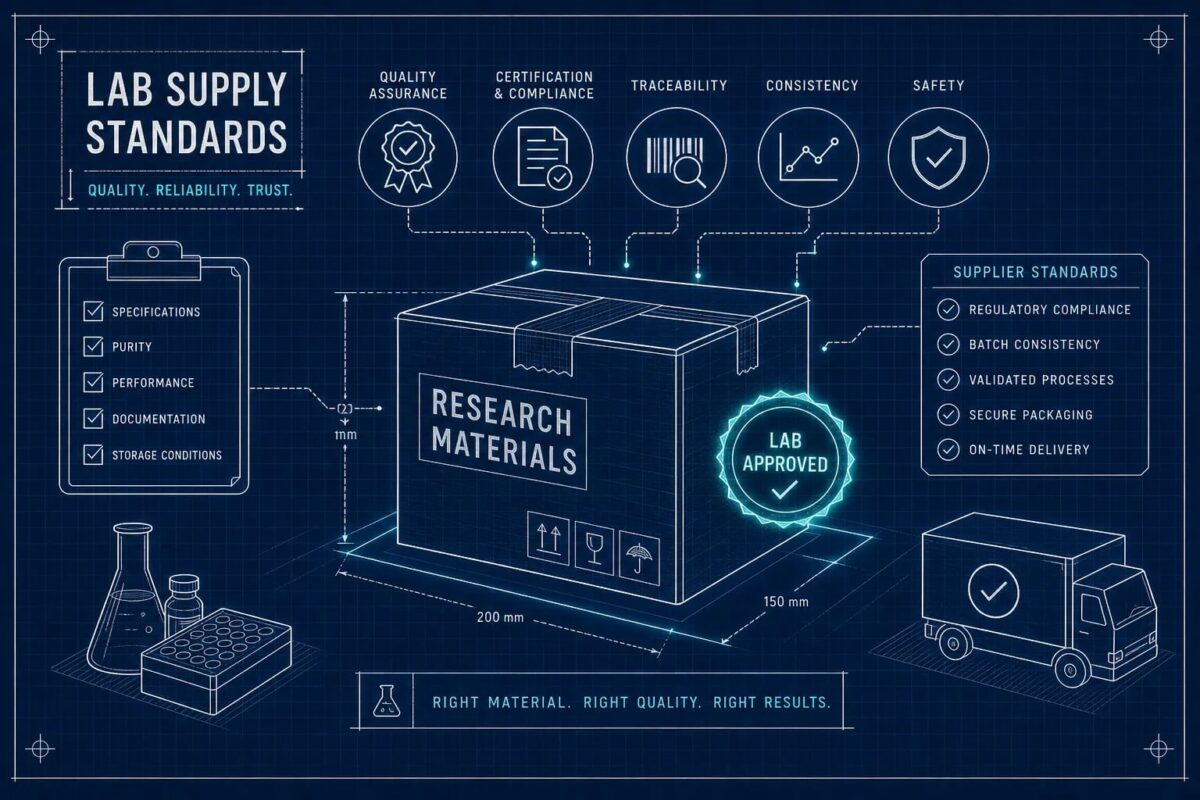
This article covers what you need to demand from any supplier: the certifications that signal genuine competence, the documentation every shipment should include, the labeling signals that separate credible vendors from risky ones, and a practical 10-point qualification checklist you can apply before your next order.
Why substandard suppliers are a reproducibility risk, not just an inconvenience
Most researchers view vendor selection as a one-time administrative decision made at the point of first purchase. The reality is that every experiment built on material from an unqualified supplier accumulates risk across the entire data set. Reagent variability, undisclosed lot-to-lot inconsistency, contamination, and unlabeled impurities are among the most frequently cited causes of irreproducible results, a concern documented by initiatives such as the NIH Reproducibility Initiative and echoed in multiple Nature surveys on research reliability. The costs compound fast: wasted bench time, retracted findings, and failed audits that damage careers and institutional reputations alike.
The link between vendor quality and research reproducibility
Undisclosed purity variation is one of the clearest examples of how vendor quality directly corrupts data. If a compound is 88% pure but labeled 95%, every concentration calculation, dose-response curve, and comparative measurement is off from the beginning. The protocol can be perfect, the equipment fully calibrated, and the analysis rigorous, none of that matters if the input material isn’t what the label says it is. Lot-to-lot inconsistency in purity, composition, or biological activity is one of the most preventable causes of non-reproducible assay results. Preventing it starts with demanding lot-specific documentation before any material enters your workflow.
What institutional and regulatory auditors look for
Regulatory reviewers, IRBs, and GLP-compliance auditors scrutinize supplier qualification records alongside experimental protocols, and that scrutiny has intensified as reproducibility concerns have become a formal compliance issue. A researcher who can produce a well-written SOP but can’t provide the Certificate of Analysis for a key reagent lot is exposed during any formal audit. Reviewers want to see that the material used was qualified, traceable, and verified, not just purchased. Supplier documentation is now treated as part of the experimental record, and labs that don’t maintain it are carrying a compliance risk they often don’t recognize until it’s too late.
Research material supplier standards: certifications to require
Not every certification applies to every supplier type. The mistake most researchers make is treating ISO 9001 as sufficient proof of quality when evaluating a technical chemical or analytical material vendor. It’s a starting point, not a complete picture. Understanding which certification corresponds to which capability lets you evaluate vendors based on what they can actually prove.
ISO 9001, ISO/IEC 17025, and ISO 17034: what each one proves
ISO 9001 confirms that a documented quality management system exists. It covers consistent production, process documentation, and service management, useful baseline evidence, but it doesn’t confirm technical competence to test or characterize the materials a supplier sells. ISO/IEC 17025 closes that gap: it certifies that a supplier’s testing or calibration laboratory operates with technical competence, including validated methods, traceability, and accurate reporting. If the supplier performs analytical testing on the compounds they sell, you want ISO/IEC 17025 accreditation alongside the quality system credential.
ISO 17034 is the third piece. It applies specifically to reference material producers and confirms that the supplier can produce materials with controlled homogeneity and stability. For buyers of certified or analytical reference materials, the combination of ISO 17034 and ISO/IEC 17025 is the credibility benchmark. If a vendor can’t point to both, you’re relying on their assertions rather than accredited evidence.
GMP, GCLP, and when these frameworks apply
GMP (Good Manufacturing Practice) applies when materials feed into regulated pharmaceutical or biologic manufacturing. If your lab compound is a starting material for a drug product or biologic, the supplier’s manufacturing controls should align with GMP-level requirements. GCLP (Good Clinical Laboratory Practice) matters for labs generating data for regulatory submissions in clinical research contexts, for example, during an IND-enabling study or a sponsored clinical trial where data quality is subject to FDA scrutiny. Most general research compound buyers won’t require either framework, but recognizing when they become relevant prevents you from accepting inadequate controls at exactly the moment the stakes are highest.
ISO 20387 and biobank-specific sourcing
When a supplier provides biological specimens, primary tissues, or biobank-derived materials, ISO 20387 is the relevant international standard. It addresses biobank competence, impartiality, and consistent operation across collection, processing, storage, and distribution of biological specimens. If you’re sourcing primary human tissue or biobank-derived cell material and your supplier can’t reference ISO 20387, ask specifically how they demonstrate equivalent controls. A supplier that can’t answer that question clearly is not a qualified source for regulated biological materials.
Documents you should receive before trusting any shipment
The documentation package from a qualified supplier isn’t optional paperwork. It’s the evidentiary record that supports every use of that material in your research. Many suppliers provide boilerplate documents covering a product line rather than a specific lot. That approach is not acceptable, and recognizing the difference is a practical skill worth developing.
What a legitimate Certificate of Analysis must include
A CoA is only valid when it references the exact lot or batch number that appears on the container label. Beyond that identifier, it should list actual test results, not just “passes specifications”, and include purity data with the specific analytical method used to derive it. Per NCCIH documentation guidance, a usable CoA includes the product name, date of manufacture, lot number, expiration date, fill weight, specification, method of analysis, acceptance criteria, actual result, storage conditions, and authorizing signatures with dates. A generic CoA that applies to a product line rather than a specific lot provides no meaningful quality assurance. When a supplier sends that kind of document, ask directly for a lot-specific version. If they can’t provide one, that supplier is not qualified.
Safety Data Sheets, traceability records, and storage documentation
Beyond the CoA, a reputable supplier provides a current SDS that accurately reflects the material’s hazard profile, lot-traceable production or release records, and explicit documentation of storage and shipping conditions. The SDS must match the specific formulation, not a generic version for a compound class. Storage and transport documentation confirms the material stayed within specification from production to your receiving dock. If a supplier can’t provide all three document types for a given lot, the integrity of that lot is unverifiable and it should not be used in research intended for publication or regulatory submission.
Labeling standards and pre-fulfillment review practices that matter
Proper labeling is not a cosmetic detail. It’s one of the clearest indicators of whether a supplier operates a structured quality system. Inconsistent naming, abbreviated compound identifiers without systematic conventions, and missing lot numbers are common markers of low-rigor operations. The label is the first place you can detect a problem, which means it also functions as a supplier quality signal before you even open a package.
What proper compound labeling looks like
A correctly labeled research chemical or laboratory compound carries the standardized chemical name, CAS number, lot number, purity grade, storage conditions, and research-use designation. For any hazardous chemical sold commercially in the U.S., OSHA’s GHS-aligned labeling requirements (per HazCom 2012) add the product identifier, signal word, hazard statements, pictograms, precautionary statements, and supplier identification. Any deviation from this structure, informal or abbreviated names used without a systematic naming convention, for example, signals that the quality controls behind that label may be equally inconsistent.
Why pre-listing and order review stages reduce fulfillment errors
Some platforms build in structured review stages before a product ships or even before it’s listed. A pre-listing review process, when applied consistently, catches classification errors, naming inconsistencies, and documentation gaps that fully automated systems miss. Research Chem Hub, for example, applies a standard naming format across all listings, runs a manual pre-listing review before any product goes live, and includes an internal confirmation stage before fulfillment, practices the platform applies as part of its quality commitment to research customers. When you evaluate any compound vendor, ask specifically whether they have a pre-listing review process and what their order confirmation procedure includes. The answer tells you how seriously that vendor treats quality control before anything ships.
Research material supplier standards checklist: 10 qualification steps
A risk-based qualification program doesn’t need to be complex, but it does need to be sequential. Running these steps in order gives you structured evidence at each stage before you commit further resources to a vendor relationship.
The onboarding and document verification sequence
- Send a supplier questionnaire asking for certifications, deviation history, testing protocols, and quality system documentation before any other contact.
- Request and verify documentation: lot-specific CoAs, current SDS, accreditation certificates, traceability records, and calibration evidence for QC testing equipment.
- Perform a desktop risk assessment to rank the supplier by criticality before placing any trial order. Higher-criticality suppliers warrant deeper review.
- Test a sample lot against your own acceptance criteria before granting full approval. Paperwork confirms claims; independent analytical testing confirms the material.
Audit criteria, change notification, and ongoing monitoring
- Define audit scope and frequency based on supplier criticality. Higher-risk suppliers should receive more intensive assessment, including on-site or remote audits covering CAPA, change control, training, and data integrity.
- Include a change-notification clause in your quality agreement. The supplier must notify you before any changes to materials, processes, test methods, or specifications.
- Track CoA conformance and complaint history over time as a performance record, not just for compliance, but to detect drift before it affects your data.
- Set a requalification schedule tied to supplier risk level. Risk-based guidance commonly supports annual review for critical suppliers; less critical vendors may warrant a longer interval depending on your institutional policy.
- Monitor delivery quality continuously, including shipping condition documentation, lot number consistency, and packaging integrity on receipt.
- Establish disqualification criteria in advance. A vendor relationship should end when a supplier cannot provide a lot-specific CoA, cannot produce a current SDS, shows inconsistent labeling across lots, has no documented quality system, or refuses to answer qualification questions.
Applying these standards protects more than your data
The audit trail isn’t overhead, it’s the evidence a reviewer will ask for by name when your manuscript goes under scrutiny. Researchers who apply structured research material supplier standards before placing orders protect their data, their reproducibility record, and their institution’s compliance standing. That’s not administrative caution. It’s the difference between bench time that produces findings you can defend and bench time that produces noise you can’t explain when a reviewer asks which lot of reagent you used in experiment three.
Start with the documentation checklist the next time you evaluate a new vendor. Ask for a lot-specific CoA, a current SDS, and explicit storage and shipping documentation. Use the certification framework to rank suppliers by quality tier: ISO 17034 paired with ISO/IEC 17025 for reference material producers, ISO 9001 as a baseline quality management signal, and ISO 20387 when biological specimens are involved. Then apply the 10-point checklist before approving any new supplier and build a requalification schedule into your lab’s vendor management process.
Some U.S.-based platforms are raising their internal standards by adopting structured pre-listing review processes, consistent naming conventions, and documented fulfillment controls. The skill is knowing what proof to ask for, and being willing to walk away from suppliers who can’t provide it. Research Chem Hub publishes its documentation standards and is available to answer supplier qualification questions prior to ordering.
