
Buy Research chemicals Online
12 Red Flags to Spot Before Buying Research Chemicals
Sep
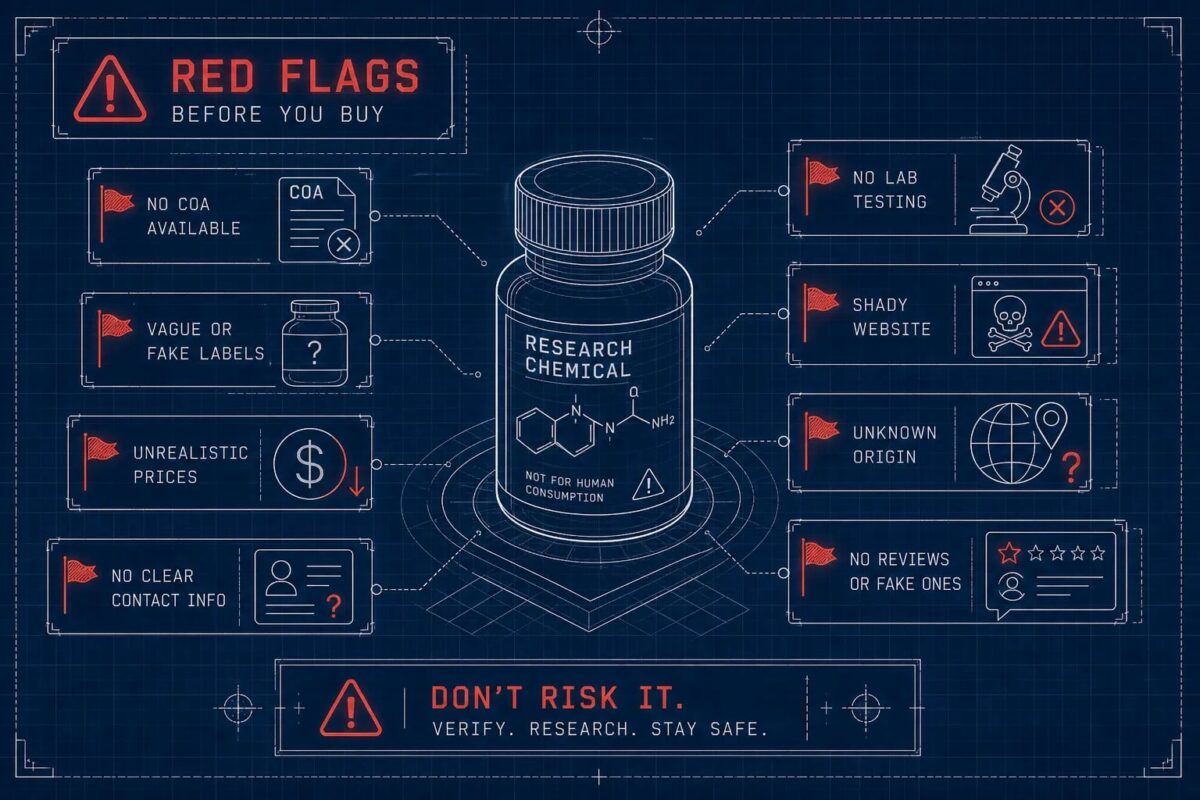
Many buyers shopping for research chemicals online focus almost entirely on price and whether the product name matches their search, and skip any deeper verification. That limited approach is exactly why bad vendors stay in business. If you’ve ever wondered what are red flags when buying research chemicals online, the answer starts before you ever click “add to cart.”
The research chemical market is genuinely easy to fake. Gray-market legal status, anonymous shipping culture, and a customer base conditioned not to ask pointed questions create ideal conditions for fraudulent suppliers to operate without consequence. Vendors who cut corners on sourcing, skip third-party testing, and fabricate documentation know this, and count on it.
Spotting a bad vendor is a learnable skill. The signals are almost always visible before you place an order. You just need to know what to look for. This article covers 12 specific red flags that separate legitimate suppliers from the noise, the documents you should always request and verify, and the U.S. legal reality that most buyers underestimate. Research Chem Hub is built around manual review processes, fixed classification logic, and traceable identity, exactly the kind of operational structure that’s missing from most gray-market operations.
Why this market is so easy to fake
Fraud thrives where accountability is absent. In the research chemical space, that absence is structural. Gray-market legal status means vendors often avoid scrutiny by design. Anonymous shipping gets treated as a feature. Buyers who know they’re operating in a legally ambiguous area are often reluctant to ask pointed questions about sourcing, documentation, or business registration, and that reluctance is exactly what bad actors rely on.
Unregulated chemical suppliers don’t survive despite the lack of oversight. They survive because of it. When no one asks for documentation, no one needs to produce it. The result is a market where the appearance of legitimacy, a clean website and professional-sounding product names with a disclaimer on every page, substitutes for actual operational standards.
The “research only” label is not a safety signal
Many vendors in this space put “for research use only” on their products. It costs nothing to print. It does not indicate third-party testing, accurate labeling, or lawful sale. It is a liability hedge, not a quality guarantee. Legitimate suppliers use research-use framing as a truthful description of intended use, not as a substitute for documentation or a shield against scrutiny. When a vendor’s only credibility signal is a disclaimer, that should tell you something.
Who is actually behind most RC vendor sites
Vendor anonymity is common in this market, often the norm rather than the exception. No named owner, no verifiable physical address, no reachable customer support. If something goes wrong with an order or the product itself, you have nothing to work with. Anonymity in this context is a deliberate choice made to limit accountability. Any legitimate supplier, in any regulated or gray-market industry, has a traceable business identity and operable contact infrastructure. The absence of either is a stop sign.
What are red flags when buying research chemicals online: identity, documentation, and labeling
These five red flags are the most predictive indicators of a fraudulent or unsafe supplier, and the easiest to check before you spend anything.
RF 1-2: No verifiable identity and missing contact infrastructure
A vendor with no named owner, no physical address, no working phone number, and no business registration trail is a vendor you cannot hold accountable for anything. If the “contact us” page is a form that goes nowhere, or a generic email address that gets no response, that is your answer. Legitimate suppliers don’t hide. They want you to be able to reach them because accountability is part of how they build a customer relationship. Anonymity in this market is a feature for bad actors, not a coincidence.
RF 3-4: Missing CoA and inconsistent batch records
A certificate of analysis tied to a specific lot number is the baseline document for any chemical order. That lot number should match the container label, the purchase order, and the shipping records exactly. A missing CoA is an immediate stop sign. So is a situation where the same CoA reappears across multiple different products. Batch numbers that shift between visits without explanation are a separate but equally serious problem, these aren’t administrative oversights; they indicate the documentation isn’t real.
RF 5-6: Labels that don’t match and descriptions that say nothing
Inconsistent packaging and product names that shift between listings are deliberate obfuscation. A legitimate listing names the substance, identifies its compound class, describes the intended research use, and states what documentation is available. Vague descriptions that avoid naming what the compound actually is exist for one reason: to evade scrutiny while maintaining plausible deniability. If you can’t tell from the listing what you’re buying, the vendor designed it that way.
What are red flags when buying research chemicals online: pricing, payment, and shipping
Once you’ve evaluated identity and documentation, the transactional layer of the purchase reveals the next set of problems. These four red flags are where scams become most obvious.
RF 7: Pricing that doesn’t hold up to scrutiny
Prices that drop far below what comparable verified suppliers charge, purity claims above 99.9% for complex novel compounds, and pricing that shifts significantly between visits are all signals that the vendor isn’t working from a real supply chain. Legitimate sourcing has real costs, raw materials, third-party testing, proper packaging, and logistics all require spending. A price that assumes none of those costs exist probably means none of them were incurred.
RF 8-9: Payment methods built for disappearing and mismatched order details
A vendor who accepts only cryptocurrency or wire transfers, with no recourse for the buyer if something goes wrong, has structured the transaction to benefit themselves in any dispute. That is not a neutral business decision. Hard-to-reverse payment methods are a structural red flag in any gray-market purchase. Pair that with billing and shipping addresses that don’t match, or a single account placing multiple large orders in a compressed window, and you’re looking at patterns that consistently appear in fulfillment fraud, the same patterns documented in pharmaceutical gray-market and supplement fraud cases.
RF 10-11: Packaging inconsistencies and fulfillment evasion
Products that arrive in packaging different from what was listed, with no visible lot number, are essentially unverifiable. Without a lot number, the CoA you were shown is meaningless, there’s no way to confirm it applies to what’s in the container. The absence of an MSDS or SDS sheet compounds this problem. Without a Safety Data Sheet, you have no standardized hazard, handling, or exposure information for the compound. Under OSHA’s Hazard Communication Standard, SDS provision is an expected baseline for chemical suppliers operating responsibly. Its absence tells you the supplier doesn’t treat this as a real chemical operation.
How to actually verify a CoA and what lab tests prove
The next section shifts from warning signs to what legitimate documentation looks like and how to confirm it holds up, because knowing what’s missing only helps if you also know what the real thing looks like.
RF 12: What a fake or low-quality CoA looks like
A CoA on supplier letterhead only, without a named third-party laboratory, is not sufficient. Full stop. Legitimate CoAs include a report number, the name and contact details of the issuing lab (ideally ISO/IEC 17025 accredited), a dated signature from an authorized person, and test methods appropriate to the compound being analyzed. Common fabrication tells include results that are suspiciously round (exactly 99.00% across multiple lots), identical numeric results appearing across different products, and test methods that don’t match the compound class being evaluated.
Verify by cross-referencing the lot number against any portal or QR lookup the vendor provides. Then go further: contact the laboratory directly using contact information from the lab’s own website, not the supplier’s page, and ask them to confirm the report number is genuine. For high-stakes purchases, independent spot-testing through your own lab arrangement remains the strongest verification available.
NMR, HPLC, and GC-MS: what each test actually confirms
NMR is the strongest tool for structural confirmation. It shows the expected molecular framework and can reveal some contaminants, though NMR-inactive impurities (certain metals and salts, for example) won’t appear in the results. HPLC is the standard for purity assessment: it separates components and quantifies impurity levels by peak area, making it the reliable choice for quality control. GC-MS is reliable for identity confirmation of volatile and semi-volatile compounds and for detecting trace contaminants, but it’s a mass and spectrum match tool rather than full structural proof. A vendor who can’t point to any of these methods for their products is operating without meaningful verification. The strongest workflow combines NMR and HPLC, with GC-MS or LC-MS added depending on whether the compound is volatile or nonvolatile.
The legal exposure buyers regularly underestimate
Most buyers skip this section. They shouldn’t, it carries the most real-world consequence.
The Federal Analogue Act and what it actually catches
The Federal Analogue Act treats unscheduled compounds as Schedule I controlled substances when they are substantially similar in structure to a scheduled substance and intended for human consumption. The “research only” label does not remove this exposure. Courts look at intent of use, and the government’s burden is to prove the analogue elements and that the buyer knew what they were handling. A lab setting makes the intent argument harder to prove. Possession in a private residence, combined with evidence of use or instructions for ingestion, tips the balance in the other direction. DEA scheduling actions in 2026 have continued to add novel psychoactive substances to Schedule I, including benzimidazole-opioids and fentanyl-related compounds. The list keeps growing.
State laws that add a separate layer of exposure
Every state has its own controlled-substance schedules, and many have state analogue laws that go further than federal law. A compound that is legal to possess in one state can be prohibited in another. Interstate shipping triggers federal jurisdiction on top of destination-state law, meaning you’re subject to both frameworks simultaneously. Buyers who check federal scheduling but skip their state’s schedule are measuring only part of their exposure. Both layers need to be verified before an order is placed.
What a legitimate research chemical supplier actually looks like
After twelve red flags and a legal reality check, it’s worth being clear about what the positive case actually looks like.
The operational standards that separate real suppliers from the noise
A legitimate research chemical vendor has a verifiable business identity, a manual pre-listing review process for products before they go live, consistent naming conventions across all listings, and structured category navigation that makes the compound class and intended use clear. Documentation is available on request, not buried or withheld. Research Chem Hub is structured around these standards: manual review before products go live, fixed classification logic, and U.S.-based logistics coordination. That kind of operational discipline takes real investment, which is why most gray-market vendors don’t bother with it. Vendors who haven’t paid that cost have already answered the question you should be asking.
Checklist: what are red flags when buying research chemicals online
These five checks take under ten minutes and filter out the overwhelming majority of risky vendors. First, confirm the vendor’s identity is verifiable: a named owner, a real address, and reachable support. Second, request the CoA and cross-check it against the criteria above, named lab, matching lot number, appropriate test methods, and no templated results. Third, confirm an SDS exists for the compound and covers hazard, handling, and exposure. Fourth, verify the payment method has recourse for the buyer if the transaction goes wrong. Fifth, check both federal and your state’s scheduling status for the specific compound before ordering. None of these are difficult. Many bad vendors fail multiple checks within the first few minutes of evaluation.
The signals were always there
The research chemical market is not impossible to navigate. It’s a market that punishes buyers who don’t ask the right questions and rewards those who do. The 12 red flags covered here aren’t obscure or technical. Most are visible within the first five minutes of evaluating a vendor’s site, documentation, and payment practices.
The problem has never been that the signals aren’t there. The problem is that most buyers don’t know to look for them. Now you know what are red flags when buying research chemicals online, use this checklist before your next purchase. A bad vendor can’t survive a buyer who knows exactly what to ask for and what the right answers look like.
Read more: researchchemhub.com/blog/are-research-chemicals-legal-in-the-united-states/

I think the admin of this site is genuinely working hard for his site,
since here every material is quality based material.