
Buy Research chemicals Online
Research Chemicals vs. Pharmaceuticals: The Key Differences
Sep
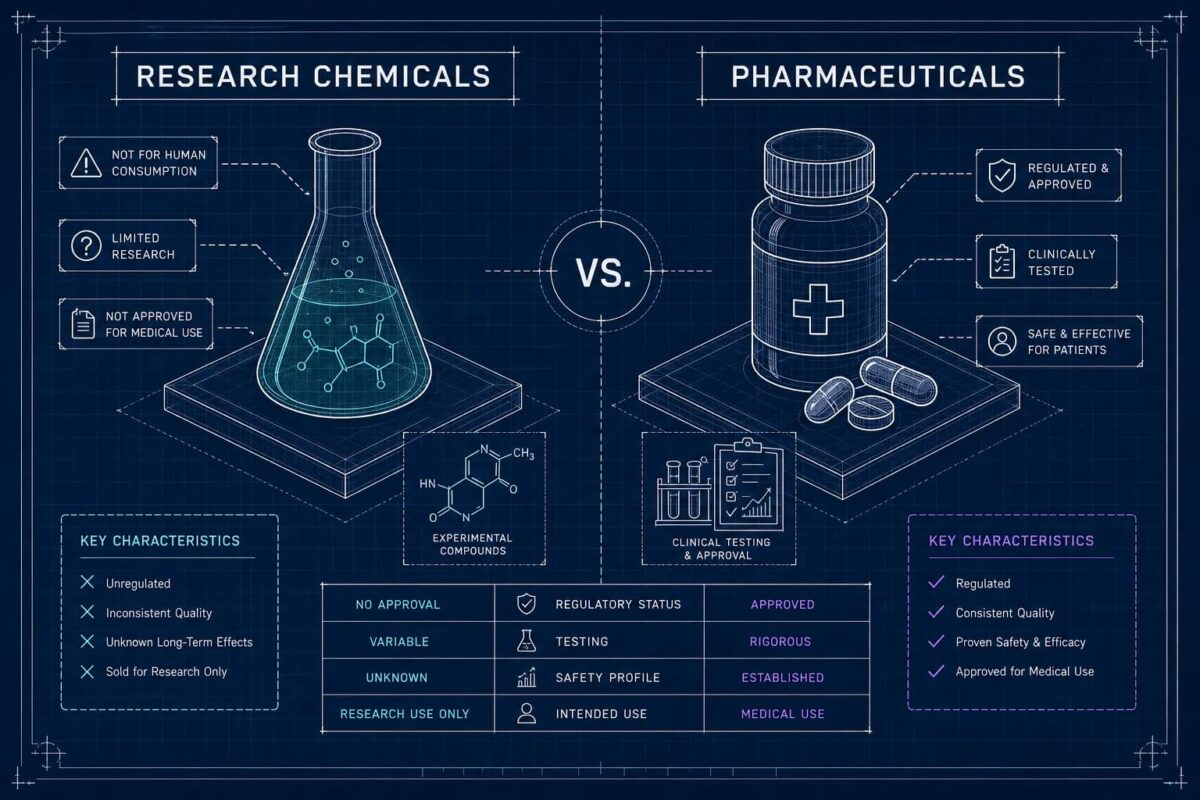
What is the difference between research chemicals and pharmaceutical compounds? Both terms describe chemical compounds, but that’s where the similarity ends. These two categories occupy fundamentally different regulatory, scientific, and legal universes, and the confusion between them carries real consequences for sourcing decisions, compliance obligations, and the safety of everyone who handles these substances in a lab setting.
The label alone proves nothing. A compound sold as a “research chemical” isn’t automatically safe, pure, or legal to possess. A pharmaceutical compound isn’t automatically relevant to an experimental study. Serious research-use-only platforms apply strict classification to every product listing precisely because this distinction carries weight. Understanding why requires unpacking what each category actually means, and how differently the regulatory machinery treats them.
What these two categories actually mean
The phrase “research chemical” carries two distinct meanings depending on context. In a literal, scientific sense, it describes substances used in laboratory settings for experimental purposes and not intended for human administration. In market usage, however, the term is commonly applied to psychoactive or novel compounds sold under “for research use only” (RUO) disclaimers. These can include synthetic phenethylamines, dissociatives, novel psychoactive substances (NPS), and other compounds that occupy an ambiguous legal and scientific space. The label does not determine regulatory status. It never has.
Pharmaceutical compounds are different in kind, not just degree. These are substances that have cleared formal development and testing pipelines and are approved for human use with defined dosing, established safety profiles, and validated manufacturing standards. The active pharmaceutical ingredients (APIs) that form the core of approved medicines go through a structured, evidence-intensive process before reaching any patient. That process is the defining feature of the pharmaceutical category, not the chemical structure of the compound itself.
Designer drugs and novel psychoactive substances fit within the broader research chemicals conversation but deserve their own framing. These are typically synthetic analogs of existing controlled substances, modified to produce similar psychoactive effects or to sidestep current drug scheduling. These compounds are frequently sold under RUO framing, which is precisely why regulators pay close attention to how they are classified, labeled, and distributed.
What is the difference between research chemicals and pharmaceutical compounds, regulatory-wise?
Pharmaceutical compounds intended for human use must pass through a formal FDA approval sequence. It begins with an Investigational New Drug (IND) application, which authorizes human clinical trials. After Phase 1, 2, and 3 trials establish safety and efficacy, the sponsor submits either a New Drug Application (NDA) for small-molecule drugs or a Biologics License Application (BLA) for biologics. Each stage requires validated manufacturing processes, clinical trial data, and FDA review. A research chemical skips this entire sequence by definition, because it is not intended for human use. The moment that intent changes, so does the regulatory exposure.
Here is the misconception that creates the most risk: the RUO label does not place a compound outside FDA jurisdiction. FDA’s authority is tied to intended use, not the text on the package. If a substance is sold with implied or explicit human-use intent, FDA can classify it as an unapproved drug regardless of what the disclaimer says. Intent, marketing language, and distribution practices carry far more legal weight than the disclaimer text itself.
DEA scheduling: a parallel system
DEA scheduling runs separately from FDA oversight. The Controlled Substances Act controls access to substances based on abuse potential, accepted medical use, and dependence liability. A compound can be a research chemical and a Schedule I controlled substance simultaneously. Approved pharmaceutical compounds like morphine and amphetamine salts are also DEA-controlled. Both frameworks apply independently, and a lab professional sourcing either category needs to understand both, not just one.
Manufacturing standards and what purity certificates don’t tell you
A 99% purity figure on a certificate of analysis can look identical whether it comes from a pharmaceutical-grade API or a research chemical. What differs is everything behind that number.
Pharmaceutical API manufacturers operate under current Good Manufacturing Practice (cGMP) regulations enforced by the FDA. These require validated equipment, documented batch records, qualified personnel, and contamination controls, along with multi-point testing that covers identity, assay, related substances, residual solvents, elemental impurities, and stability. Every batch is traceable from raw material to final product. The question cGMP answers is not just “does this batch look acceptable” but “was this batch made under a controlled, validated, and auditable system?”
Research chemical suppliers typically perform identity confirmation and basic purity testing, often via HPLC or mass spectrometry. A certificate of analysis may report high purity, but without validated analytical methods, comprehensive impurity profiling, or stability data, that figure describes only what was measured. Minor impurities and degradation products may go entirely uncharacterized. The certificate shows what passed through the instrument; it does not account for what was never tested.
The documentation gap that actually matters
The documentation gap between pharmaceutical-grade and research-grade compounds is the real differentiator. A responsible research chemical platform provides detailed, traceable documentation with each product, applies consistent naming conventions, and subjects every listing to a pre-publication review process. Research Chem Hub runs a manual verification sequence that confirms category placement, naming consistency, and RUO classification before any listing goes live, the kind of operational discipline that separates reliable sourcing from a risk transfer onto the researcher.
Safety data, toxicity evidence, and the risk of unknown unknowns
Approved pharmaceuticals carry structured safety data accumulated over years of clinical development and postmarket surveillance. Research chemicals, particularly novel psychoactive substances, mostly appear in the safety literature after something has already gone wrong.
Before a pharmaceutical compound reaches approval, it accumulates clinical trial data covering dose-response relationships, pharmacokinetics, adverse event profiles, and contraindications. After approval, pharmacovigilance systems track real-world adverse events through spontaneous reporting and postmarketing studies. This creates a compounding evidence base that informs prescribing decisions and safety labeling over the lifetime of the drug.
For most research chemicals, the primary safety record looks nothing like that. It comes from emergency department case series and poison-center surveillance. For synthetic cathinones alone, documented presentations include agitation, tachycardia, hypertension, seizures, rhabdomyolysis, acute compartment syndrome, serotonin syndrome, and fatalities. A CDC-described Michigan ED series of 35 “bath salts” cases documented agitation, delusions, hallucinations, and tremor, with the majority of surviving patients requiring hospitalization. There are no Phase II or Phase III trial datasets for these compounds, no validated dosing thresholds, and no structured adverse-event reporting system tracking them at scale.
Impurity profiles add another layer of uncertainty. A pharmaceutical API undergoes formal identification and quantification of degradants and process-related impurities. In a research compound assessed with a basic CoA, those same impurities may be present in quantities the certificate never measured. For in-vitro or non-human studies, that introduces confounding variables that are difficult to control for, and, for any human-adjacent use, compounds safety risk in ways that are hard to anticipate after the fact.
Labeling, disclaimers, and what “for research use only” actually means legally
The phrase “for research use only” communicates intended use. It signals that a compound is classified for laboratory research, not for human administration. That is a meaningful classification, but it is not a liability shield, and treating it as one is a mistake that both distributors and researchers have made at significant cost.
Courts and regulators evaluate the total picture: packaging, claims, marketing language, and distribution patterns. A disclaimer buried in fine print or contradicted by stronger marketing claims does not provide legal protection. Distributors who sell research chemicals under RUO labels while marketing them in ways that suggest broader use, or who fail to include adequate hazard information, can face failure-to-warn claims, misrepresentation claims, and consumer-protection violations. The disclaimer reduces exposure only when it accurately reflects both the product’s classification and the platform’s actual practices.
A platform that enforces RUO classification rigorously and structures its ordering process to reinforce research-use framing is doing something substantively different from one that applies the label as a marketing afterthought. The former demonstrates a genuine compliance posture. For researchers evaluating sourcing options, that distinction is not abstract, it determines whether a platform’s documentation and classification practices are reliable or purely decorative.
What this distinction means when you’re sourcing lab compounds
Grasping what is the difference between research chemicals and pharmaceutical compounds shapes every sourcing decision a lab professional makes. The documentation a supplier provides, the consistency of its classification system, and its operational accountability all reflect how seriously that supplier takes the distinction.
When evaluating any supplier, look for a certificate of analysis that names the analytical methods used, clear product classification, batch-level traceability, and consistent naming conventions across listings. Any supplier that cannot produce this documentation on request should not be part of your procurement workflow. Vague listings, inconsistent naming, and generic CoAs are signals that quality control is not a priority.
For researchers who prefer domestic sourcing, a U.S.-based supplier with a verified operational address carries meaningful advantages beyond shipping speed. That supplier is accountable to American law, easier to audit, and more accessible for compliance questions. When evaluating any platform, check whether classifications are applied consistently, whether the ordering process reinforces research-use framing, and whether the company documents its operational controls. These details reveal whether a platform treats RUO classification as a business principle or simply as a disclaimer added to limit liability.
The distinction that defines responsible lab sourcing
The RUO label matters, but only when the platform behind it enforces the label with real operational discipline. A manually reviewed catalog, consistent classification, and a verified domestic business address are not just convenience features. They are indicators that a supplier genuinely understands what is the difference between research chemicals and pharmaceutical compounds, and has built its operations around that understanding.
For anyone sourcing laboratory compounds in the United States, that understanding is not optional. It is the foundation of compliant, safe, and scientifically defensible research practice. The question of what separates a research chemical from a pharmaceutical compound belongs in every sourcing conversation, not just the ones where something has already gone wrong.
