
Buy Research chemicals Online
Are Research Chemicals Legal in the United States?
Sep
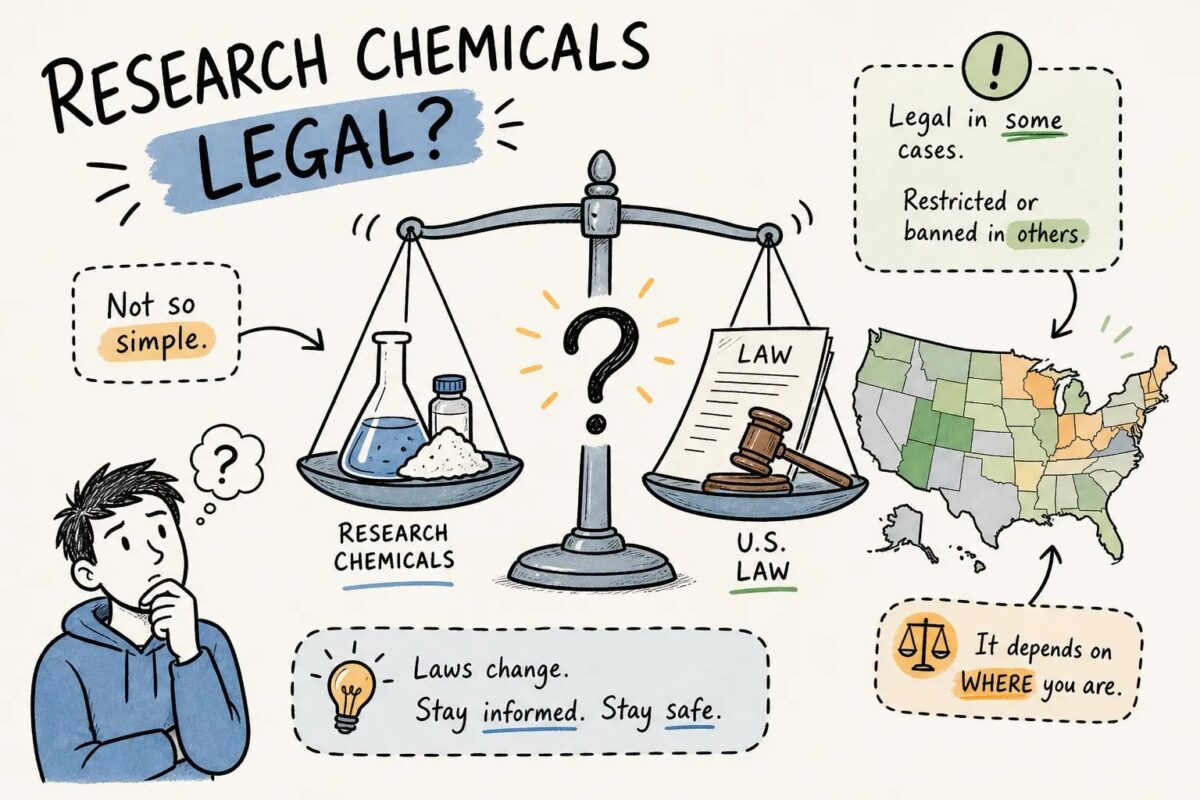
Whether research chemicals are legal in the United States does not have a clean answer. That ambiguity isn’t an accident. It’s built into the structure of the law, and it’s exactly what catches buyers off guard. Legality depends on the specific compound, its chemical structure, its current scheduling status, and, critically, the intent behind the purchase. Get any one of those wrong and the legal picture shifts completely.
Some U.S.-based platforms apply structured product classification and consistent labeling to help buyers understand what they’re actually purchasing. That kind of transparency has real value. But it’s worth being direct: a clear product label and a legal exemption are not the same thing. This article is about what the law actually says, not what the market implies.
How the Controlled Substances Act classifies research chemicals
The Controlled Substances Act, codified at 21 U.S.C. §§ 801 et seq., organizes regulated substances into five schedules based on three factors: accepted medical use, abuse potential, and safety profile. Schedule I sits at the top of the restriction scale. Substances there have no currently accepted medical use under federal law and carry the highest abuse potential. They can only be handled lawfully in the context of federally approved scientific research. Many research chemicals land explicitly in Schedule I; others sit in a gray zone just adjacent to it, meaning they lack formal scheduling but share structural or pharmacological features with controlled substances.
The critical mistake buyers make is treating “unscheduled” as a synonym for “legal to use however you want.” It isn’t. The DEA holds statutory authority to add, transfer, or remove substances from schedules through administrative action, and it exercises that authority on a regular basis. A compound that is unscheduled today can be in Schedule I within a matter of months. Relying on unscheduled status as a legal strategy is building on sand.
Between 2021 and 2026, the DEA scheduled or maintained emergency Schedule I control over a significant number of substances. Fentanyl-related substances as a class remained under temporary Schedule I control through multiple congressional extensions, including a period running through 2025, with nine specific fentanyl analogues proposed for permanent scheduling that year. In 2026, seven benzimidazole-opioids and dipentylone were placed into Schedule I effective April 3rd, consistent with DEA Federal Register notices for those actions. Synthetic cannabinoids including 4F-MDMB-BINACA and 5F-MDMB-PICA were also brought under control during this period. The pace of scheduling actions makes one thing clear: novel chemical structure is not a stable legal position.
Are research chemicals legal in the United States? The Federal Analogue Act explains the gray zone
The Federal Analogue Act, at 21 U.S.C. § 813 and § 802(32)(A), is the statute that closes the gap between scheduled substances and unscheduled ones. Under this law, a substance qualifies as a controlled analogue if it has a chemical structure substantially similar to a Schedule I or II drug and produces, or is claimed to produce, substantially similar stimulant, depressant, or hallucinogenic effects. “Substantially similar” is intentionally broad. Courts have applied it to novel psychoactive substances and designer drugs that weren’t yet scheduled at the time of prosecution.
How courts assess structural similarity
Federal courts don’t use a single rigid structural test. They compare molecular scaffolds, functional groups, ring systems, and other features through expert testimony. Vagueness challenges to the standard have mostly failed because courts find that if structural similarity is demonstrable on the evidence, the statute applies. After McFadden v. United States (2015), the government must also prove the defendant’s knowledge, but that standard can be met through circumstantial evidence: how a product was marketed, who bought it, in what quantities, and at what price.
The human consumption element is where most of the legal action happens. The Federal Analogue Act only treats a substance as a Schedule I controlled substance when it is intended for human consumption. That single clause is what gives “research use only” labeling its perceived legal shield. The distinction is real in statute. The problem is that prosecutors don’t read labels in isolation; they read them alongside everything else.
What “research use only” actually means under federal law
A “research use only” label is not a legal exemption. The statute at 21 U.S.C. § 813(b) explicitly states that labeling or advertising a substance as not for human consumption is not sufficient by itself to defeat an intent finding. Courts and the DEA look at the totality of circumstances: the buyer’s profile, the platform’s marketing language, the product’s pharmacological profile, pricing relative to legitimate laboratory supply, and any communications suggesting the actual purpose was human use.
Prosecutors build intent from circumstantial evidence: consumer-style product descriptions, personal-use quantities, packaging, dosing information, customer messages, and bulk sales patterns. If the surrounding context points toward human use, the label doesn’t override it. This is where the most dangerous misconceptions about research chemical purchasing live, and it’s worth being unambiguous about it.
That said, how a compound is presented to a buyer genuinely matters for understanding what they’re purchasing. Platforms that apply consistent naming conventions, category-based organization by chemical class, and a manual review process before listings go live give buyers a clearer picture of a compound’s classification and what legal category it occupies. Research Chem Hub is one example of a vendor that structures its catalog this way. Transparency about classification is more useful than vague marketing language. It doesn’t create legal protection, but informed buyers make better decisions in a legally complex space.
State-by-state drug laws add another layer of complexity
Federal law sets the floor. States build their own structures above it, and those structures vary significantly. There is no uniform national research chemical code. Some states maintain their own controlled substance schedules and precursor chemical lists that operate entirely independently of DEA scheduling. A compound sitting in a federal gray zone may be explicitly scheduled under the law of the state where the buyer lives.
Fifteen states have enacted their own analogue statutes that function independently of the Federal Analogue Act. According to compiled state criminal code analyses, Alaska, Arizona, California, Colorado, Connecticut, Florida, Georgia, Hawaii, Iowa, Minnesota, New Mexico, North Carolina, Oklahoma, Oregon, and Virginia all have analogue-type provisions in their criminal codes. Beyond those, state-by-state drug laws differ in important practical ways:
- California maintains state-level controlled substance and precursor chemical lists distinct from federal DEA schedules; possession with intent to manufacture illegal drugs is a felony under Health and Safety Code § 11383, carrying up to seven years.
- Wisconsin requires both federal DEA registration and a separate state controlled substance board registration for research use of controlled compounds.
- Florida treats manufacturing Schedule I or II substances as a second-degree felony with a maximum of 15 years; lesser schedules carry up to five years.
The practical takeaway is straightforward: check both federal and state law for your specific jurisdiction before purchasing or using any compound in this space. The federal schedule is not the complete picture.
The lawful path to obtaining controlled compounds for research
For researchers who want to handle controlled substances legally, the process runs through DEA Form 225, the registration application for researchers, analytical labs, and related activities (see 21 CFR § 1301.18 and DEA Diversion Control guidance). For Schedule I substances specifically, the DEA requires the application to include a detailed research protocol, investigator qualifications, institutional backing, and a site security plan. The DEA then assigns an investigator, may conduct a site review, and can request additional information before approving the registration. Approvals take six weeks on the short end and up to six months when protocol review, inspections, or state compliance steps add time, consistent with timelines documented in university research compliance guidance.
The typical lawful workflow for Schedule I research looks like this: confirm the compound’s schedule and any state-level requirements; secure institutional approval, including protocol review, storage documentation, and security planning; apply for DEA registration using Form 225; complete any follow-up DEA review or site inspection; and maintain ongoing inventory controls and renewal deadlines once registered. Some states require parallel state-level registrations that run alongside the federal process.
This process is designed for credentialed researchers with institutional backing. It is not designed for individual buyers. A “research use only” purchase from a gray-market vendor does not substitute for DEA registration and does not provide the legal cover that formal registration does. The formal process exists because operating outside it exposes researchers to felony liability, even when intent is genuinely scientific.
Enforcement reality: what the penalties actually look like
Federal penalties under the Controlled Substances Act are not subtle. Simple possession of a controlled substance carries up to one year and at least a $1,000 fine for a first offense under 21 U.S.C. § 844, with higher exposure for repeat offenses. Distribution moves into serious felony territory, with penalties that scale by drug type and quantity. Large-scale trafficking of certain Schedule I and II substances carries 10 years to life and up to $10 million in fines for individuals, or $50 million for organizations. Asset forfeiture, enhanced penalties when death or serious injury results, and loss of federal benefits are common collateral consequences.
The DEA’s enforcement pattern over recent years makes the direction clear. Fentanyl-related substances were kept under class-wide temporary Schedule I control through multiple congressional extensions. Designer drugs including 25I-NBOMe, eutylone, and N-ethylpentylone have been brought under control. Seven benzimidazole-opioids were placed into Schedule I effective April 3, 2026. Synthetic cannabinoids have faced repeated scheduling actions. The message is consistent: novel chemical structure alone is not a defense, and the DEA’s willingness to use emergency and class-wide scheduling means the legal landscape can shift faster than a buyer can track.
The honest answer: are research chemicals legal in the United States?
Whether research chemicals are legal in the United States depends entirely on what the compound is, whether it qualifies as a controlled analogue under the Federal Analogue Act, what your state’s drug laws say, and what your intent can be shown to be. The Federal Analogue Act exists specifically to close the loophole that unscheduled status creates. “Research use only” labeling creates a framing, not a legal exemption, and courts have drawn that distinction repeatedly.
For anyone serious about working with these compounds in a legitimate context, the only defensible path runs through DEA registration, institutional oversight, and state-level compliance. Understanding the actual legal framework is the starting point for any responsible decision in this space. Everything else is assumption, and assumptions in this area carry real consequences.
Frequently asked questions
Are research chemicals legal to buy in the United States if they aren’t scheduled?
Not necessarily. An unscheduled compound may still qualify as a controlled analogue under the Federal Analogue Act if its structure is substantially similar to a Schedule I or II substance and it is intended for human consumption. Unscheduled status is not the same as legally unrestricted status.
Does a “research use only” label make a purchase legal?
No. Under 21 U.S.C. § 813(b), labeling alone does not defeat an intent finding. Courts evaluate the full context of a purchase, including marketing language, quantities, pricing, and communications, to determine actual intent.
Do I need to check my state’s laws separately from federal law?
Yes. Fifteen states have independent analogue statutes, and many others maintain controlled substance schedules that go beyond federal DEA scheduling. A compound that is uncontrolled at the federal level may be explicitly scheduled in your state.
What is the legal way to obtain Schedule I compounds for research?
The legal pathway runs through DEA Form 225, which requires a detailed research protocol, institutional backing, investigator qualifications, and a site security plan. The process can take six weeks to six months. Individual buyers without institutional affiliation are not eligible for this registration.
