
Buy Research chemicals Online
Best Research Chemical Suppliers in the USA (2026 Guide)
Sep
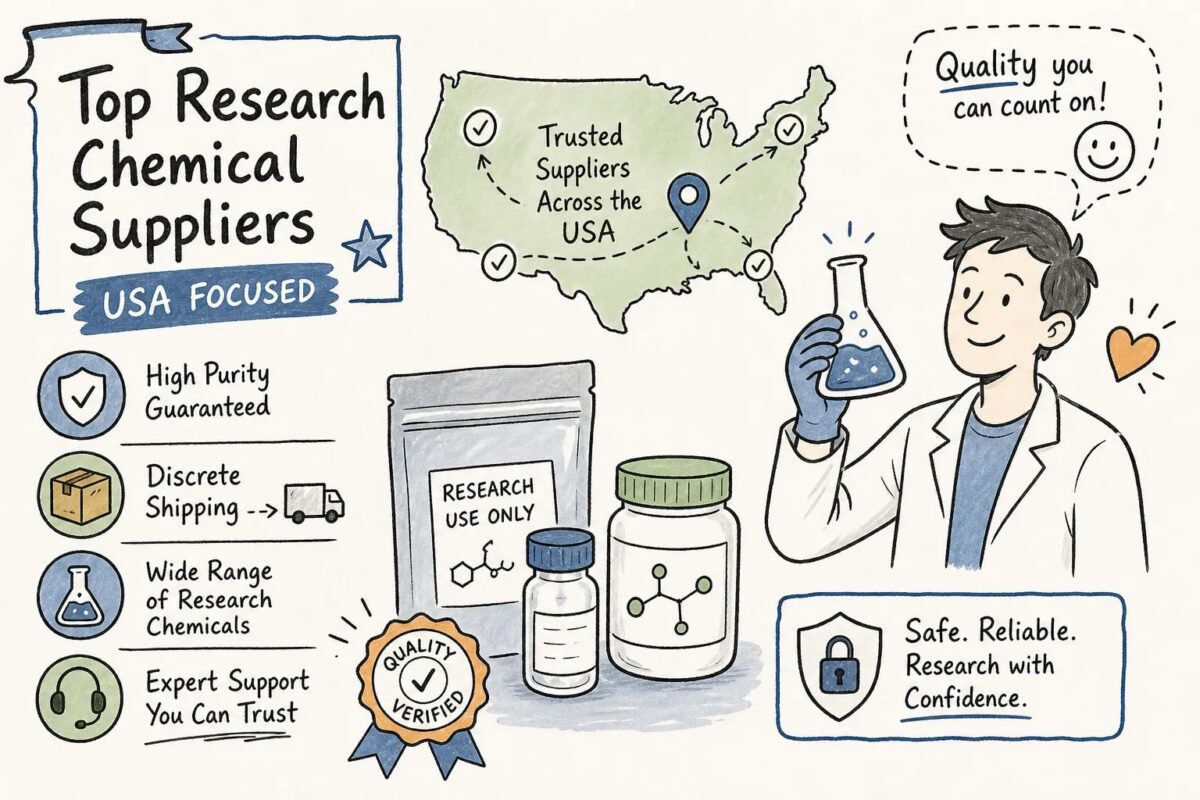
Finding the best research chemical supplier USA has to offer is harder than most buyers expect. Dozens of platforms operate online, but only a fraction hold up to basic due diligence: verifiable business addresses, consistent documentation, research-use-only labeling, and domestic logistics that actually deliver on time. The gap between a trustworthy supplier and a problematic one isn’t always obvious from a product catalog or a price sheet.
This guide lays out a practical framework for evaluating any U.S.-based supplier before you place an order. It covers what separates legitimate vendors from risky ones, how to read the documentation that matters, what red flags should stop a purchase cold, and what the federal regulatory landscape actually requires. Platforms like Research Chem Hub, which operates out of Kenedy, Texas with a manual pre-listing review process and research-use-only framing on every product, are built around exactly these standards. By the end, you’ll have a clear vetting framework you can apply immediately.
What actually separates a legitimate supplier from the rest
Most buyers evaluate suppliers on price and catalog size. Those are trailing indicators. The real signals of legitimacy are operational and structural, and they show up before you ever place an order.
Research-use-only labeling as a non-negotiable baseline
Every legitimate research chemical supplier labels its products explicitly for laboratory and research use only. This isn’t a legal formality you can skip past. It signals how the platform positions itself and defines its intended customer base. A supplier that blurs this line, or uses vague product descriptions that could appeal to non-research buyers, is either non-compliant or deliberately ambiguous. Research-use-only framing on every listing is a baseline requirement, not a premium feature.
Manual pre-listing review as a quality control signal
How a platform handles its own product listings tells you a great deal about its internal discipline. Suppliers that manually review, categorize, and validate each listing before it goes live operate with a level of control that protects buyers downstream. Unnamed listing practices, inconsistent naming conventions across the catalog, and missing CAS numbers are red flags hiding in plain sight. A platform that bulk-imports product data without review is a platform that can’t vouch for what it’s selling.
Why domestic sourcing matters more than most buyers realize
Many researchers default to the cheapest available option without factoring in the logistical and compliance advantages that come with ordering from a U.S.-based scientific chemical distributor. Price comparisons look different once you account for transit risk, customs unpredictability, and the practical limits of recourse when something goes wrong with an overseas order.
Shipping timelines and fulfillment reliability
Domestic U.S. suppliers typically dispatch in-stock orders the same day or within one business day, with transit times running two to five business days depending on carrier and service level. Overseas vendors commonly take six to ten days at minimum, and customs delays can extend that significantly with no reliable estimate. For research teams working against project timelines, that difference in predictability is not trivial. Domestic sourcing also gives you real recourse if a shipment arrives damaged or incorrect, recourse that’s considerably harder to exercise with a vendor based in another country.
Accountability through a verified U.S. business address
A real, verifiable U.S. business address is more than a trust signal. For procurement teams at research institutions, it’s a compliance requirement. A supplier operating from a confirmed domestic location, such as Research Chem Hub’s registered base in Kenedy, Texas, can be cross-checked against state business registries, contacted through standard channels, and held accountable through U.S. legal frameworks. Anonymous or offshore vendors offer none of that. If your institution’s procurement policy requires a verifiable supplier address, an overseas option fails at step one.
How to choose the best research chemical supplier USA: COA and SDS verification
Most researchers know they should request a Certificate of Analysis. Fewer know what separates a valid one from a template designed to look credible without actually proving anything. The same goes for Safety Data Sheets. These documents are only useful if you know what to look for, and knowing what to look for is exactly what distinguishes experienced procurement staff from buyers who get burned.
The minimum elements every valid COA must include
A valid COA must include the supplier’s name and address, exact product identification with CAS number, the lot or batch number that matches the physical container label, manufacture and retest dates, and tested parameters showing actual numerical results. Not just “pass.” Actual values, with the test method used and an authorized QA signature with a date. If a COA lists only pass/fail results with no methods and no numerical data, it cannot be used to meaningfully qualify the product.
The lot number and authorized signature are the two most critical fields because they tie the paper record to a specific released batch. Without them, the document is effectively unverifiable. Treat any COA that omits either field as a non-starter, regardless of how professional the rest of it looks.
What third-party testing documentation should actually show
There’s a meaningful difference between a supplier-issued summary and a true third-party test report. A credible third-party report names the independent laboratory, includes its accreditation status, ties all results to a specific lot number, and shows actual analytical data such as chromatograms or spectra. A summary sheet printed on the supplier’s own letterhead and attributed to an outside lab is not third-party documentation. To verify authenticity, check the named lab against the relevant accreditation body’s public registry and confirm that the scope of accreditation covers the tests listed. If the lab doesn’t appear in any registry, the report is unverifiable.
Red flags that should stop a purchase before it starts
Experienced lab managers and procurement coordinators treat vendor vetting as hygiene, not optional. The red flags below appear consistently in DEA enforcement actions and institutional procurement audits, and most of them are visible before any payment changes hands.
Payment and contact information that doesn’t hold up
Any request for payment via cryptocurrency, wire transfer to a personal account, gift cards, or peer-to-peer payment apps is a clear disqualifier for a legitimate research chemical purchase. Pair payment red flags with contact information checks: a supplier that lists only a P.O. box, an address that doesn’t match its business registration, or contact details that can’t be confirmed through a public directory or state registry is not a supplier you can hold accountable. When you search the relevant state’s business registry, a legitimate U.S. vendor’s physical operating address should resolve without ambiguity.
Documentation inconsistencies that expose unverified vendors
Document-level red flags often reveal supplier problems before a single dollar changes hands. Watch for COAs where the lot number doesn’t match the product label, invoices with vague or generic chemical descriptions, and certificates from laboratories that don’t appear in any accreditation registry. One of the most telling signs is when the business name differs between the website, the invoice, and the shipping label. Consistent documentation across all touchpoints is a basic operational control that legitimate suppliers maintain without exception. If documents don’t agree with each other, they can’t be trusted individually either.
What a properly structured research chemical platform looks like
The standards above translate into specific, observable features of how a platform operates. Research Chem Hub is one example of what these standards look like when implemented consistently rather than selectively.
How platform structure reflects internal discipline
A supplier’s website architecture reveals a lot about how seriously they manage their operations. Category-based navigation with consistent naming conventions, clear product classification, and explicit research-use-only framing on every listing signal active management of what goes up. Research Chem Hub enforces fixed naming conventions across its catalog, runs a manual pre-listing verification process that includes category placement and naming validation, and maintains research-use-only labeling as a platform-wide standard. That’s the difference between a platform built around compliance and one where listings are managed opportunistically.
From checkout to fulfillment: what a controlled order process signals
A trustworthy order process includes a structured checkout, an internal confirmation stage before fulfillment begins, and domestic logistics coordination managed from a verified U.S. location. This matters for compliance-conscious procurement staff who need to demonstrate that their supplier has documented operational controls, not just a professional-looking website. Research Chem Hub’s fulfillment process includes an internal confirmation stage before orders move to dispatch, coordinated from its Texas operations base. That procedural control protects both the researcher and the supplier, and it’s the type of structure that holds up when a procurement audit asks how a vendor was selected.
Legal and shipping considerations U.S. buyers need to understand
Regulatory compliance for research chemical procurement is a layered set of federal frameworks that apply differently depending on the specific compound. Understanding the basics keeps buyers out of avoidable problems and keeps wholesale research chemical vendors and their customers on the right side of enforcement.
Federal frameworks that apply to research chemical purchases
The Toxic Substances Control Act (TSCA) governs new chemical substances and includes an R&D exemption under Section 5(h)(3) for small-quantity research use, codified at 40 CFR 720.36, provided the work is directly supervised by a technically qualified individual and health-risk notifications are handled correctly.
The Controlled Substances Act (CSA) schedules certain compounds and regulates listed chemical precursors, with DEA registration requirements for researchers handling controlled substances. Researchers working with Schedule I substances must register using DEA Form 225, maintain executed order forms (DEA Form 222) for Schedule I and II purchases, and keep records readily retrievable for at least two years.
The applicable rules depend on the specific compound, not on the “research chemical” label as a general category. When in doubt, confirm the compound’s scheduling status at both the federal and state levels before sourcing from any lab reagent vendor in the United States.
What compliance-conscious procurement looks like in practice
Institutional buyers and lab managers should verify that a supplier’s labeling and documentation match what their institution’s procurement policy requires before the first order goes through. Confirm whether the compound is scheduled at the state level even if it’s federally unscheduled, because state-level controls sometimes differ. Keep complete documentation from every order: COA, SDS, invoice, and shipping record together form the paper trail that protects the institution if the sourcing decision is ever reviewed. Procurement teams that treat documentation as optional create liability for their institutions. Those that treat it as a standard operating procedure don’t have that problem.
Applying this framework before your next order
Finding the best research chemical supplier USA procurement teams can rely on isn’t about the largest catalog or the lowest price per milligram. It’s about finding a platform that operates with structural discipline, consistent documentation standards, and the domestic accountability that legitimate research procurement requires. Those qualities are observable before you place an order, if you know where to look.
Verify the business address against a state registry. Demand a full COA with actual test results and a matching lot number. Confirm research-use-only labeling across the supplier’s entire catalog. Walk away from any vendor that can’t produce verifiable third-party documentation or requests non-standard payment. Research Chem Hub is built around exactly these standards, from its verified Texas address to its manual pre-listing review process and research-use-only framing on every product in its catalog. For buyers who need a trusted U.S.-based supplier, that combination of documented controls and domestic accountability is what separates a reliable source from a risk.
If a vendor can’t satisfy the documentation and accountability checks outlined here, don’t order. Reach out to the Research Chem Hub team directly with any questions about specific compounds, documentation, or the ordering process. Use this checklist to choose the best research chemical supplier USA has available before placing your next order.
