
Buy Research chemicals Online
How to Find Reliable Research Chemical Suppliers in the U.S.
Sep
Finding a dependable research chemical supplier in the United States is harder than it should be. Professional-looking websites are easy to build, and a polished catalog page tells you very little about whether a supplier actually has the operational standards your procurement process demands. The market is fragmented: some vendors are genuinely structured and accountable, others auto-populate listings from bulk data with no verification step, and a few are outright fraudulent. The difference between them is not always obvious from a search result.
This guide is a practical decision framework for anyone asking where to find reliable research chemical suppliers in the USA. It covers where to look, how to evaluate what you find, what documentation to verify, and which warning signs to take seriously. Understanding what makes a supplier’s structure meaningful, consistent research-use-only labeling, manual listing review, and verified domestic sourcing, will help you evaluate every option you encounter, whether you’re comparing large-scale laboratory chemical vendors or specialty domestic platforms.
What separates a trustworthy U.S. supplier from an unreliable one
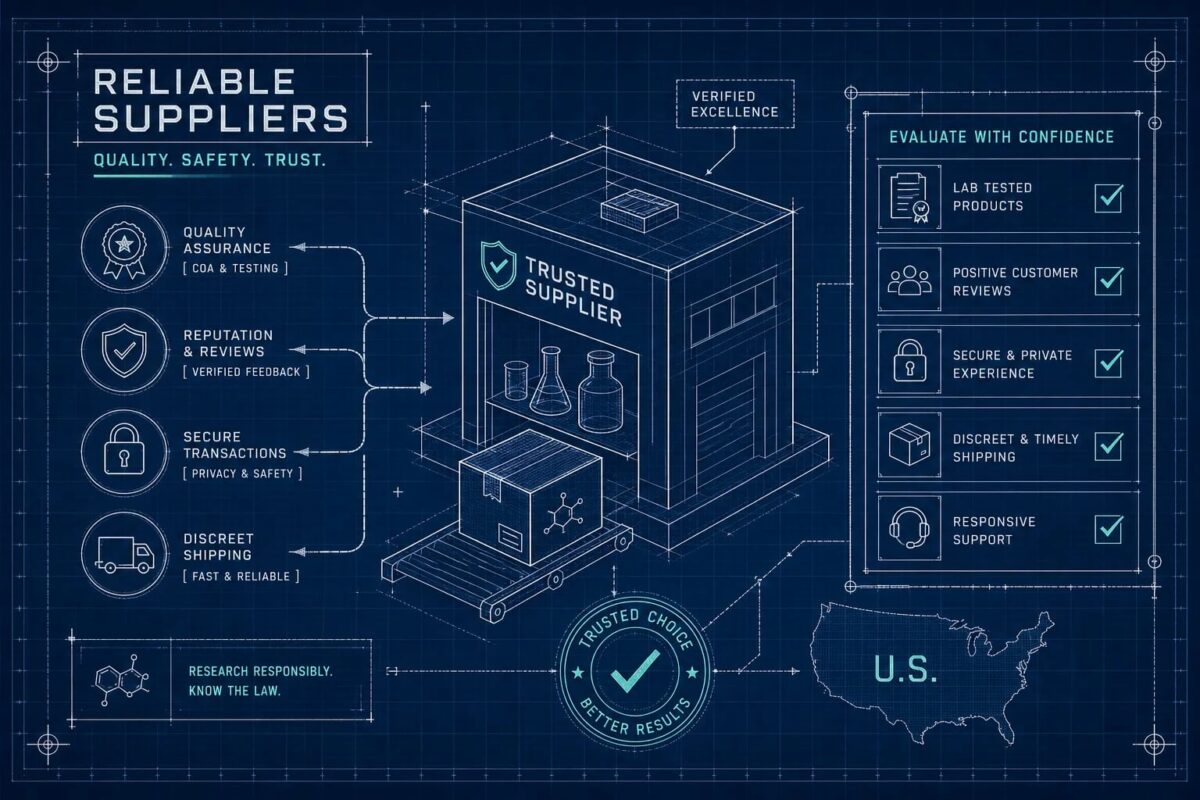
Credibility in this space is not about catalog size or website design. It comes from structural accountability: the processes a supplier runs before a product ever reaches a listing, and the documentation they maintain after it does. Three criteria separate reputable chemical vendors in the U.S. from those that should be avoided: labeling consistency, a verifiable domestic presence, and a structured pre-listing review process.
Research-use-only labeling and listing consistency
A supplier worth trusting enforces “research use only” framing uniformly across every product listing, not just in a terms-of-service page buried in the footer. Consistent labeling conventions signal that the platform has actual operational standards. This matters especially for institutional buyers who need documentation trails that hold up internally, because a single inconsistently labeled listing can create procurement headaches downstream.
A verified domestic address and supply chain transparency
A U.S.-based physical address is not a formality. It means shipping timelines are predictable, there is a real entity accountable for what is sent, and disputes have a clearer resolution path. A verified domestic address functions as a trust signal not just for shipping reliability, but for overall operational accountability. A verifiable U.S. address generally improves traceability and legal recourse relative to unverifiable overseas vendors, though buyers should still confirm business registration and payment terms independently before placing any order.
Manual review processes and listing quality
Suppliers that run every product through a structured verification step, covering category placement, naming validation, and consistency confirmation, produce listings researchers can actually rely on. This is a meaningful contrast to high-volume platforms that auto-populate listings without quality checks. A manual pre-listing review process is one of the clearest signals that a supplier takes accuracy seriously, because it costs time and resources they could otherwise skip. When evaluating research reagent suppliers, ask directly whether listings are reviewed individually or generated from bulk data imports.
How to find reliable research chemical suppliers: sourcing channels compared
The right sourcing channel depends on your procurement context. The three main channel types, large-scale distributors, compound discovery platforms, and specialty domestic suppliers, each serve different needs and carry different tradeoffs. Matching your situation to the right channel type saves time and reduces the risk of ending up with a vendor that cannot meet your documentation or compliance requirements.
Large-scale lab distributors for routine procurement
For academic and institutional labs, Sigma-Aldrich/MilliporeSigma, Fisher Scientific, and Spectrum Chemical are the established go-to sources among laboratory chemical vendors. They offer broad catalog coverage, GHS-compliant SDS documentation, and institutional account structures with negotiated pricing. Access is often gated through university buying accounts or approved procurement workflows, and pricing is typically tied to institutional contracts, which limits access for independent researchers or smaller teams operating outside those structures.
Vendor discovery platforms and chemical marketplaces
eMolecules, MolPort, and CAS/SciFinder are not suppliers themselves. They are compound discovery tools that aggregate vendor data, making them useful for sourcing hard-to-find structures or cross-referencing which suppliers carry a specific CAS number. SciFinder integrates supplier data directly into its substance records, making it strong for early-stage research planning. eMolecules and MolPort function more like scientific chemical marketplaces for comparing availability and pricing across sources. These platforms surface options; they do not guarantee supplier quality. Every vendor they point to still needs independent vetting.
Specialty domestic platforms for specific compound categories
For researchers sourcing specific compound categories like lysergamides or phenethylamines, structured specialty domestic platforms represent a distinct option. The characteristics that matter in this segment: category-based navigation with fixed naming conventions, individual listing review rather than bulk data imports, and research-use-only framing enforced consistently across the full catalog. Research Chem Hub is one domestic platform built around those operational controls, procurement staff evaluating it can review its catalog structure and contact the team directly to confirm its documented processes. For teams that need a U.S.-accessible supply source with consistent operational standards, that kind of structural consistency is not incidental. It is the point.
How to verify a supplier’s credentials before ordering
Regardless of how well-known a supplier appears, verifying credentials is a required step before any order is placed. The two most critical document categories are the Certificate of Analysis and the Safety Data Sheet, both tell you more about a supplier’s actual quality controls than any marketing claim will.
What a legitimate COA should include
A batch-specific Certificate of Analysis must include the lot number, analysis date, purity assay value, the analytical method used (not just a purity percentage), impurity data where relevant, and a QA authorization signature. The critical verification step is matching the lot number on the COA exactly to the container label and shipping documents. In standard laboratory practice, chromatograms and spectra are harder to falsify than a summary PDF, so their presence is a meaningful positive signal. If a supplier’s COA is a clean one-page summary with no method citation and no lot-specific data, treat it as incomplete.
Checking SDS documents, ISO claims, and GMP certifications
A current GHS-compliant SDS must be 16 sections, must match the product identity and CAS number, and must carry a current revision date. For ISO or GMP claims, ask for the certificate number, issuing body, facility address, and expiration date, then verify through the certifier’s registry directly. ISO 17025 applies to the testing laboratory’s competence in analytical testing, while ISO 9001 applies to the supplier’s quality management system. They are different credentials and are not interchangeable, so a supplier citing one when you asked about the other is a sign they do not understand their own documentation.
Red flags that indicate a risky or fraudulent vendor
The following patterns are specific warning signs, not general caution. If you encounter more than one of these with a single vendor, find an alternative before proceeding.
Documentation gaps and listing quality problems
Watch for: COAs available “on request” that never materialize, generic template COAs without lot numbers or method citations, no SDS provided, and purity claims without any analytical evidence. At the catalog level, inconsistent product descriptions, copied text, or unrealistic breadth (“everything in stock”) without verifiable sourcing are signals that the supplier is not operating from real inventory or real processes. These patterns are common among low-quality lab reagent distributors that aggregate listings without any underlying quality infrastructure.
Identity, pricing, and payment warning signs
No verifiable physical address, a domain that does not match the stated business identity, prices significantly below market without explanation, and demands for 100% advance payment are all high-risk indicators. Requests for untraceable payment methods without supporting invoices or paperwork are among the clearest fraud signals in this space. Add behavioral red flags: evasive answers to direct documentation questions, high-pressure urgency, or communication that goes quiet after payment is confirmed.
Legal and procurement context U.S. researchers need to understand
Read this section before you source, particularly if your work involves compounds that may intersect with DEA scheduling or federal analogue classifications. This is practical context, not legal advice.
DEA registration, controlled substances, and the Federal Analogue Act
Researchers working with Schedule I compounds must obtain a DEA researcher registration and submit a research protocol as part of the application. Schedule I and Schedule II, V research require separate DEA registrations under different application categories, typically filed on DEA Form 225, with Schedule I applications also subject to 21 CFR 1301.18. State controlled-substance authority is required before DEA will process the application. The Federal Analogue Act is the other critical consideration: substances substantially similar to Schedule I or II drugs can be treated as controlled if intended for human consumption. This is why “research use only” framing is not just a supplier preference. It is a meaningful legal distinction that affects how compounds are handled, documented, and sourced.
Institutional vs. commercial procurement and the TSCA R&D exemption
Institutional procurement channels, Fisher Scientific or VWR through a university buying account, for example, offer negotiated contract pricing and workflow-controlled access, but that access is restricted to authorized buyers. Commercial platforms offer open access and smaller order quantities, which is practical for independent researchers or smaller teams. The TSCA R&D exemption covers non-controlled chemicals manufactured or processed in small quantities for legitimate scientific research, but it comes with specific conditions: supervision by a technically qualified individual and proper regulatory notifications. Independent researchers need to confirm which procurement route fits their compliance framework before ordering.
A practical checklist to use before placing an order
After evaluating a supplier against every criterion above, this checklist gives you a structured final review before committing to a purchase. It applies whether you’re working with large institutional distributors or smaller specialty domestic platforms, the documentation standards do not change based on supplier size.
Document and compliance verification steps
- Confirm the COA is lot-specific and matches the container and shipping documents exactly
- Verify the analytical method is named, not just a purity percentage
- Check the SDS: 16-section GHS format, correct CAS number, current revision date
- Independently verify any ISO or GMP certificates through the issuing body’s registry
- Confirm the supplier’s physical address through public business records
Supplier accountability and operational checks
- Verify the domestic address and logistics information are publicly documented
- Confirm every product in the catalog is consistently labeled for research use only
- Check whether listings go through a structured review process or are auto-populated from bulk data
- Look for a checkout confirmation stage before fulfillment as a possible signal of an internal verification step
- Search for researcher reviews or community references outside the supplier’s own site
The process is the protection
Finding reliable research chemical suppliers in the United States is a process, not a one-time search result. Reliable options exist at every level, from large institutional distributors to structured domestic specialty platforms, but each requires the same due diligence on documentation, labeling, and operational accountability. Skipping any step in that process is where procurement problems begin.
Research Chem Hub is built around the structural needs of researchers who require consistent research-use-only framing, manual listing verification, and verified domestic sourcing in one place. Its catalog and contact information are publicly available for procurement staff who want to evaluate it directly against the criteria covered in this guide.
Use the checklist above before any new vendor relationship. The documentation requirements, red flags, and legal context covered here apply regardless of which supplier you choose, whether that’s one of the major laboratory chemical vendors, a supplier directory find, or a specialty domestic platform. Getting that framework right before you order is the most reliable way to protect your research, your institution, and your compliance standing.
